
Roof Trusses vs Rafters: Key Differences Builders Should Know
Key Takeaways:
Choosing between rafters and roof trusses is a critical decision builders and contractors have to make. Your final choice can affect your project’s:
- Timeline
- Structural performance
- Cost
While rafters may have been the traditional choice, they are not the fastest or most affordable choice. That is why roof trusses dominate residential construction now – they’re efficient, strong, and cost-effective.
Residential units and buildings might be made from the ground-up but they are planned from the top-down. Roof framing is one of the most critical structural components of any building – one that determines your project’s capacity to handle snow loads, wind forces, and structural weight, among others.
Now you have two choices here – you can either opt for rafter or trusses. But which one of them is the best? That is the real million-dollar question, if there ever was one.
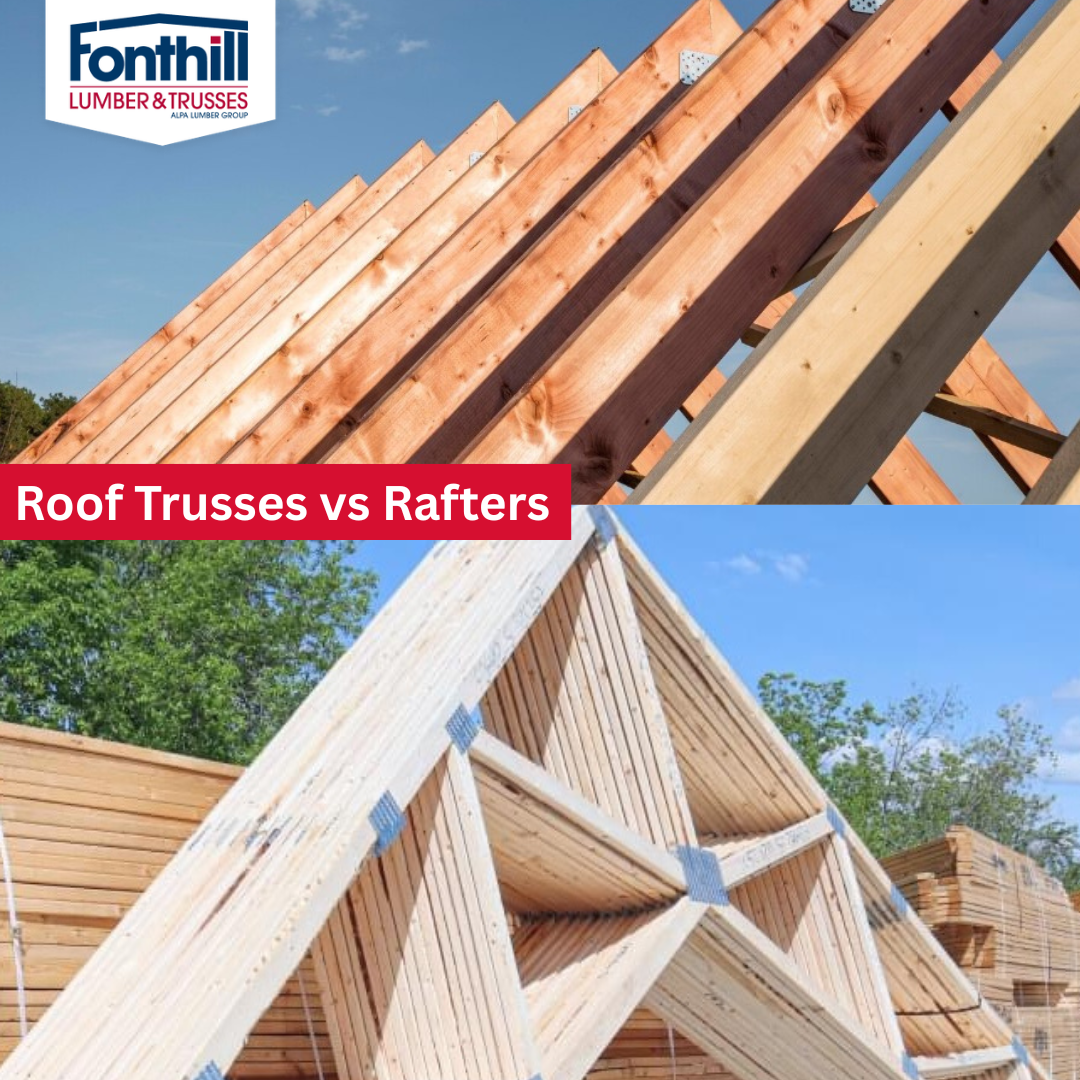
Rafters are the more traditional choice. They are made of members that are connected to the ridge board at the top, finding their way down to the exterior walls. Every individual rafter is a sloped beam that is more than capable of handling roofing materials and sheathing.
On the other side, you’ve got roof trusses. They are prefabricated structures made of individual lumber members that are connected to each other in a triangular format. This particular shape helps them distribute various loads evenly and efficiently across the entire structure.
If you ask us, roof trusses are all the rage right now. Builders actually prefer prefabricated framing because it is easier and faster to install, reduces labor costs, is precisely built, and offers consistent performance.
But that is just the tip of the iceberg, or rather the truss. In today’s blog, Fonthill Lumber Inc. – Ontario’s favorite roof truss fabricator will walk you through the essential differences between roof trusses and rafters that every builder should know.
Structural Design Differences Between Trusses & Rafters
When it comes to the distribution of structural loads, rafters and roof trusses take a very different approach. That’s where they majorly differ from each other, in fact. Allow us to explain.
How rafters transfer loads to walls
Rafters rely on exterior walls to carry loads. These framing systems push the weight of external forces directly from the sheathing through the rafters and straight to the exterior walls. It is important to note here that each member of this system works individually, so that makes the strength of every single component is important.
Rafters require additional structures to keep them upright, such as ceiling joists and collar ties. These prevent the walls from crumbling under loads.
Triangular design of engineered trusses
Roof trusses are designed keeping triangular geometry in mind. The reason why this shape is most commonly used is because it ensures the even distribution of weight across all members, thus reducing stress on the individual components of the system.
Their triangular structure also makes them more stable. The impact of external forces, such as snow loads, for example, is distributed equally across the entire framework, thus preserving its structural integrity.
Role of webbing in truss strength
The secret to a roof truss’s strength lies in its internal webbing. These angled members help in the equal distribution of load from the top to the bottom chord, thus supporting the creation of roofs with longer spans without relying on the construction of internal load-bearing walls.
Structural engineering considerations
Before getting roof trusses designed for your next project, you should consider the following. These ensure that variables such as span length, snow loads, wind uplift, and material strength are accounted for:
- The distribution of load across framing members
- Span requirements of your project
- The roof system’s overall structural stability
- Local building code requirements and engineering approvals
Installation Process: Rafters Vs Prefabricated Trusses
Whether you go for trusses or rafters for roof framing, you should know that one of them will install faster than the other, and that their installation processes are wildly different.
On-site rafter framing process
Rafters have to be built painstakingly onsite. Carpenters measure, cut, craft, and assemble each member individually while trying to maintain perfect alignment with the ridge board and wall plates. Needless to say, this is a highly time-consuming and labor-intensive process.
Factory-built truss installation
Installing trusses is really as easy as 1-2-3. Custom-made trusses arrive on your site, pre-assembled and ready to install. No cuts, no last modifications required. All you have to do is have a crane or a large piece of lifting equipment, place the roof system directly onto the building frame, thus cutting down installation time significantly.
Just remember to take extra precautions if you are installing trusses in a termite-prone zone.
Construction speed differences
Rafters are not a good idea for projects with tight timelines, as they can take several days to weeks to build and install, depending on the size and complexity of your project. As for trusses, it only takes one day to install, so you know which roof system wins this round.
Labor requirements and efficiency
In the truss vs rafter construction debate, the former trumps the latter when it comes to labor costs and overall efficiency, too. You only need a few skilled labor hours to get the job done with trusses.
A typical roof truss installation process includes:
- Planning the structural layout
- Preparing the site for installation
- Placing the prefabricated roof system in its correct spot
- Conducting post-completion inspection
You can learn more about trusses and how they function in our handy roof truss guide.
Design Flexibility & Architectural Considerations
Design possibilities are the forte of both rafters and roof trusses. However, both also carry certain limitations. So your final choice should be really based on your project’s requirements.
Custom roof shapes with rafters
With rafters, you get the flexibility to create roofs with complex, custom shapes. That is because each rafter can be directly cut and adjusted on-site. This gives you complete control over the final look and shape of the structure, making rafters a great choice for renovation and restoration projects.
Engineered truss design capabilities
Modern truss engineering has enabled the creation of roofs with varying designs and shapes. Now you can get residential roof trusses with complex rooflines, vaulted ceilings, and large spans to suit the requirements of your project.
Open attic space considerations
Rafters allow the creation of large attic spaces that are relatively easy to access for homeowners. However, trusses are not far behind either and can also be used to create living spaces right underneath the roof.
Hybrid roof framing systems
Certain projects are complex enough to require a rafter/roof truss hybrid to ensure structural integrity while allowing architectural flexibility.
Snow Load Performance
Nothing’s harsher and more demanding than Ontario’s rough climate. The province’s weather can put any roofing system through its paces.
Roof load requirements in Ontario
When building and installing roof systems in Ontario, it’s critical to ensure they meet the province’s snow and wind load requirements so that structural damage can be prevented.
How trusses distribute snow loads
Roof trusses are highly efficient in managing snow loads. The weight of accumulated snow is distributed equally across all its members, which helps in the preservation of its structural integrity. This is unlike rafters, where the weight falls on each individual member.
Structural performance of rafters in heavy snow
Rafters can handle heavy snowfall as long as each member is larger in size and placed close to each other to ensure sound structural performance.
Engineering recommendations for cold climates
Trusses are generally the preferred roofing method for snow-prone regions as they are specifically designed with snow loads in mind. They also tend to hold better under the weight of heavy snow.
A climate evaluation checklist can help you ensure your project ends up with snow-friendly trusses:
- Verify truss capacity against local building codes
- Figure out active snow load zones
- Determine the roof pitch as per snow loads
- Implement structural reinforcement for the heavy snowfall region
Residential Roof Truss Types
If you have zeroed in on roof trusses for your construction project, the next thing you have to do is determine which truss type is best for it. Popular choices are:
King post trusses
Simple and easy to construct, king post trusses consist of a single vertical member that is supported by top and bottom chords. They are great for roofs with smaller spans and straightforward designs.
Fink trusses
Fink trusses are commonly used for Ontario residential projects, thanks to their web configuration, which is highly efficient in distributing various loads across the entire system.
Scissor trusses
Scissor trusses help in the creation of impressive, high vaulted ceilings that add a unique character to any project they are a part of. In this truss type, the bottom chords slope upwards, which creates additional interior space while preserving its structural integrity.
Attic trusses
The major function of attic trusses lies in their name. This truss type is used to create living or storage spaces that are a part of the roof’s structure.
When Builders Choose Rafters Instead Of Trusses
Despite their versatility and strength, roof trusses might still play second fiddle to rafters in certain construction scenarios. These include:
Small renovation projects
Trusses can prove to be too costly and complex for small-scale repair and renovation projects. Rafters, on the other hand, are the perfect choice because they are easier to install and customize onsite.
Complex roof designs
Niche architectural roof styles require highly customized framing that should leave room for adjustments, which rafters do.
Limited delivery access
For locations where truss delivery is unlikely, such as highly remote areas, rafters might prove to be a better roof framing option.
Historic building restorations
Heritage buildings were traditionally made of rafters, and as such, require building materials that closely match their original structure.
Choosing The Right Roof Framing System For Your Build
By now, it’s clear that there is no objectively right or wrong roofing system. The “right” framing method is one that ticks all the right boxes by meeting your project’s requirements, including its structural demands and construction timelines.
Project size and structural needs
Large residential builds are better off with roof trusses as their preferred framing method, as they are capable of achieving wide spans in a much more space-efficient manner.
Construction timeline considerations
Nothing installs faster than roof trusses. So if your project has a rigid deadline that must be adhered to at all costs, you know what to choose between trusses and rafters.
Budget and labor availability
Again, on both counts, trusses are actually a better fit for your project. They do not require more than a few labor hours to install, which makes them a very budget-friendly option overall.
Engineering requirements
Modern building codes tend to favor prefabricated trusses as they are built with compliance in mind. Assessing rafter compliance can be tricky in comparison.
The steps for selecting the perfect roof framing system for your project must include:
- A fair assessment of your project’s structural span requirements
- A careful evaluation of your project’s timeline
- An unbiased comparison of each method’s installation complexity
- A thorough review of your project’s building code requirements
- An in-depth consultation with framing experts
Conclusion: Trusses vs Rafters For Modern Construction
Roof trusses have earned the favor of most Ontario builders and contractors engaged in building modern residential projects. Their design flexibility, ease of installation, and budget-friendliness make them an easy win for most projects. Add to that their ability to handle varying loads while remaining solid as a rock under pressure are bonus features that make trusses popular.
Looking for the best trusses for your project? Fonthill Lumber Inc. custom manufactures roof trusses of exceptional quality in its Welland, Ontario facility. Each of our trusses is assembled and shipped onsite for smooth and easy installation. Contact us to learn why our trusses are the perfect fit for your project.
FAQs
Are roof trusses stronger than rafters?
The triangular shape of roof trusses makes them structurally stronger than rafters. This shape also allows equal load distribution across its framework.
Are trusses cheaper than rafters?
The cost of trusses and rafters varies on a per-project basis. However, trusses are generally more cost-effective as they reduce material waste and require less labor time.
Can rafters replace trusses in modern construction?
Although rafters are still commonly used, trusses are the preferred framing method for modern construction due to their efficiency and superior performance.
Do roof trusses allow attic space?
Yes. Attic trusses, in particular, are engineered to allow the construction of usable living or storage spaces within the roof.
Which roof framing system lasts longer?
Both rafters and trusses offer excellent longevity and can last for decades if they have been properly designed and installed in a code-compliant manner.
